
A great home theater experience starts with what you see. Sony’s new BRAVIA 9 II and BRAVIA 7 II bring a different approach to display technology with True RGB – a backlight system that independently controls red, green, and blue LEDs.
The goal is straightforward: give the display more precise control over color and light while maintaining the brightness and contrast expected from a premium television. For homeowners, that can mean richer color, strong contrast, impressive brightness, and a more consistent image across the room.
Sony introduced the BRAVIA 9 II and BRAVIA 7 II in 2026, and the True RGB technology was prominently demonstrated at CEDIA Expo 2026 in Denver. The BRAVIA 9 II was also recognized as a Best New Hardware winner in the 2026 CEDIA Smart Home Awards Americas.
What Makes True RGB Different?
Traditional LED/LCD televisions use a white LED backlight behind the LCD panel, with the LCD layer creating the colors viewers see. Sony’s True RGB approach changes where color control begins.
With True RGB, red, green, and blue light sources are independently driven in the backlight. Sony’s RGB Backlight Master Drive Pro is designed to precisely control these individual RGB light sources. The result is a display architecture that gives the television another level of control over color and brightness.
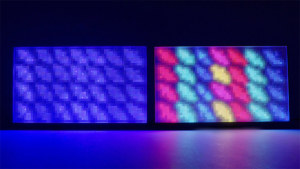
Sony describes this as creating color at both the backlight LED and LCD layers. The company says the approach can produce richer and brighter colors, improve contrast and depth, and reduce unwanted white flare in bright areas.
Color Starts Behind the Screen
The important change is not simply the number of LEDs. It is the ability to control the red, green, and blue components of the backlight independently.
That additional control is intended to help the television reproduce a wider range of colors while preserving high brightness. In practical viewing, this matters for scenes with strong color variation – from natural skin tones and detailed landscapes to bright sports graphics, city scenes, and cinematic highlights.
Sony also combines True RGB with its processing and display technologies to manage color, contrast, motion, and brightness as part of the overall viewing experience.
BRAVIA 9 II: Sony’s Flagship True RGB Display
The BRAVIA 9 II sits at the flagship end of Sony’s True RGB lineup. It uses RGB Backlight Master Drive Pro with independently controlled RGB light sources and adds technologies such as RGB Triluminos Max and Luminance Booster Pro.
The BRAVIA 9 II is available in screen sizes extending to a 115-inch class model, making it especially relevant for dedicated theaters and large media rooms where screen size and image impact are central to the design.
For rooms with multiple seating positions, Sony also includes X-Wide Angle Pro technology, designed to help maintain color and contrast when viewers are sitting away from the center of the screen.
BRAVIA 7 II: Bringing True RGB to More Spaces
The BRAVIA 7 II brings Sony’s True RGB architecture into a broader range of room sizes, with models from 50 to 98 inches.
It combines independently controlled RGB LEDs with Sony’s processing and contrast technologies. Depending on the model, features include RGB Backlight Master Drive Pro, Luminance Booster, RGB Triluminos Pro, XR Contrast Booster 20, X-Wide Angle, and XR Motion Clarity.
For gaming and high-frame-rate content, the BRAVIA 7 II also supports HDMI 2.1 features including 4K/120, VRR, and ALLM.
What Does This Mean for Homeowners?
For a homeowner, display specifications only matter when they translate into a better experience. The value of True RGB is the additional control it gives the display over the light and color reaching the screen.
That can be especially relevant in rooms where the television needs to perform across different viewing conditions. High brightness can help maintain impact in brighter spaces, while wide-angle technologies are designed to preserve the viewing experience for people sitting farther to the side.
In a dedicated theater, the same technology can support the larger-scale experience homeowners expect from a premium display: strong contrast, vibrant but controlled color, detailed highlights, and a picture that remains engaging across a large screen.
From the Living Room to the Home Theater
A television is only one part of a professionally designed media space. The display has to work with the room, the audio system, lighting, seating, networking, and control system around it.
A BRAVIA display can be integrated into a larger home technology system alongside surround sound, distributed audio, lighting control, motorized shades, home automation, media servers, and gaming equipment. The right combination depends on the room and how the homeowner intends to use it.
That is where system design becomes important. Screen size, viewing distance, seating layout, ambient light, speaker placement, equipment location, and control requirements all influence the final experience.
Why CEDIA Expo Matters
CEDIA Expo 2026 in Denver provided an opportunity for the custom-installation and smart-home industry to see Sony’s True RGB technology in a professional environment. Sony showcased the BRAVIA 9 II, including its 115-inch class display, as part of its CEDIA presence.
The technology was also recognized by CEDIA’s 2026 Smart Home Awards Americas, where the Sony Consumer Integrated Systems BRAVIA 9 II True RGB TV was named a Best New Hardware winner.
For integrators, demonstrations like these are useful because display technology is increasingly being evaluated not only as a television product, but as a component within a complete residential technology system.
The Bigger Picture: Where Display Technology Is Going
Premium televisions are taking several different approaches to controlling light and color. OLED creates light at the individual pixel level. Mini LED uses a large number of small LEDs to improve backlight control. Sony’s True RGB approach adds independently controlled red, green, and blue LEDs to the backlight itself.
These approaches are different ways of solving the same fundamental challenge: controlling light more precisely so the display can produce a convincing image across dark scenes, bright highlights, and complex colors.
For homeowners, the important question is less about the technology label and more about how the display performs in the actual room where it will be installed.
A Better TV Experience Starts With the Right Technology
The BRAVIA 9 II and BRAVIA 7 II show how quickly display technology is evolving. True RGB gives Sony another way to control color and brightness, while the company’s processing, contrast, viewing-angle, and anti-reflection technologies are designed to work together as part of the complete display.
For a home theater or media room, the best result comes from looking beyond the television itself. The display, room conditions, seating, audio, lighting, and control system should all work together.
That is the difference between simply installing a large TV and designing an experience around it.
See It in the Right Environment
Interested in what a premium BRAVIA display could look like as part of your home theater or media room? Digital Media Innovations can help evaluate the display, room, audio, lighting, control, and infrastructure as one integrated system.
Contact DMI to discuss your project and determine the right display and technology approach for your space.